MotoBros Vlog · Lewisville, TX
We Cut Open OEM Motorcycle Oil Filters: Some of These Shocked Me
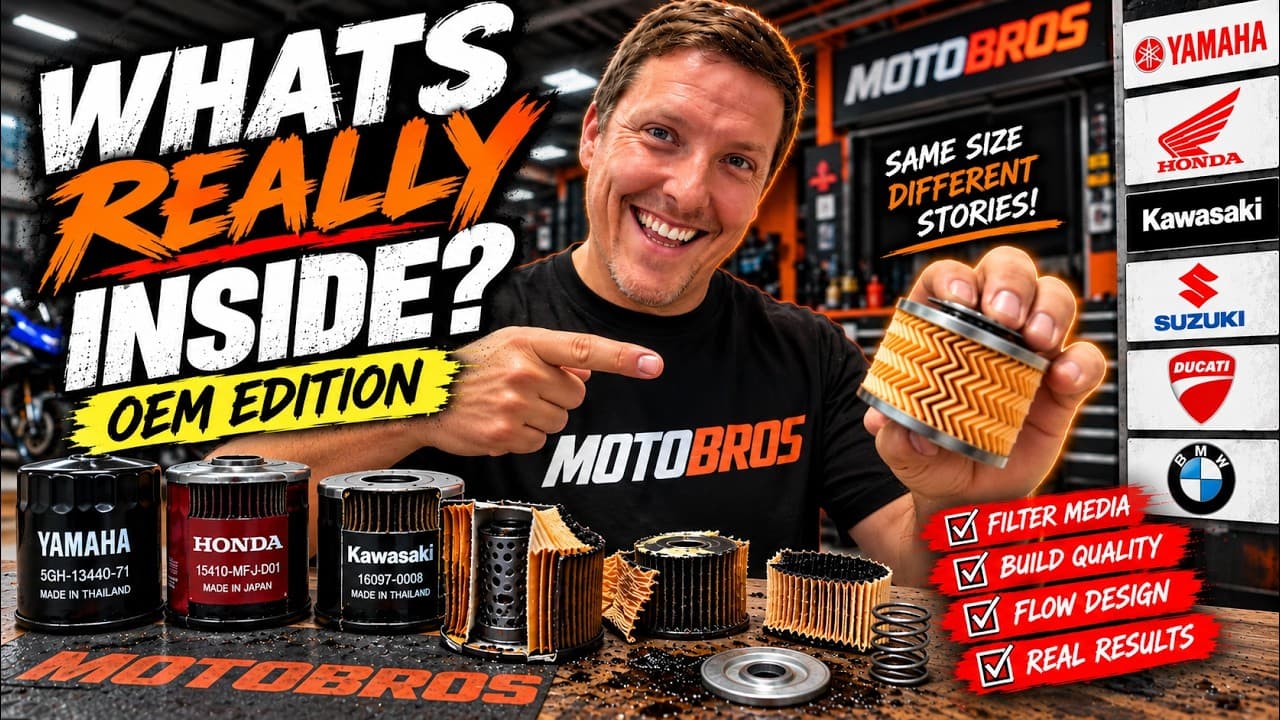
Honda, Kawasaki, Suzuki, Yamaha, Royal Enfield, Triumph, Ducati, and BMW OEM oil filters cut open next to a Hiflofiltro benchmark. Construction, pleat counts, and what the extra money looks like inside.
Read the vlog
We Cut Open OEM Motorcycle Oil Filters: Some of These Shocked Me
We Cut Open OEM Motorcycle Oil Filters: Some of These Shocked Me
You guys asked for it, so here they are.
After our first motorcycle oil-filter teardown, the comments were absolutely full of requests:
"Cut open Honda."
"What about BMW?"
"Do Ducati!"
So I went shopping.
And unfortunately for me, OEM motorcycle oil filters are not exactly cheap.
This time we've got Honda, Kawasaki, Suzuki, Yamaha, Royal Enfield, Triumph, Ducati, and BMW, and we're cutting every single one open to see what you're actually getting for your money.
We're also bringing the Hiflofiltro back as our budget benchmark.
Now, I want to make something clear before we start.
This isn't a laboratory filtration test.
We're looking at construction, pleat count, internal supports, springs, anti-drainback components, overall design, and what we can physically see once the filters are cut apart.
That can tell us a lot about how they are built.
It cannot tell us the exact micron rating, filtration efficiency, oil-flow restriction, bypass performance, or service life.
For those things, we'd need a completely different test.
But just seeing what manufacturers put inside these things?
Man, this got interesting.
The Price Difference Is Bigger Than You Might Think
Here's what I paid at the time of filming:
Hiflofiltro: roughly $8 to $9
Kawasaki OEM: $14.50
Yamaha OEM: $15.99
Suzuki OEM: $17.99
Honda OEM: $18.99
Triumph OEM: $18.99
Royal Enfield OEM: $19.99
Ducati OEM: $26.99
BMW OEM: $26.99
Obviously, pricing can change depending on the specific application and where you purchase the filter.
But immediately I had a question:
What am I actually getting for that extra money?
If an $8 aftermarket filter looks similar inside to an $18 OEM filter, where is the difference?
And if BMW and Ducati are charging almost $27, are those filters actually constructed differently?
Time to get the cutter out.
Hiflofiltro: Our Budget Benchmark
We started with Hiflofiltro because we already cut one open in the previous video.
And I've got to give this filter credit.
It's inexpensive, the gasket comes pre-lubricated on the one we examined, and internally it looked pretty dang good.
We counted roughly 53 pleats in this example.
Pleat count alone does not determine filtration quality. The dimensions and depth of the pleats, filter-media composition, efficiency, structural support, and flow characteristics all matter.
But we're using this filter as our visual benchmark because of how inexpensive it is.
Now let's see what OEM money gets us.
Honda OEM: Very Similar Construction
Honda was one of the filters everybody wanted us to cut open.
At $18.99, I was expecting to find something dramatically different.
Once we got inside, though, I immediately recognized the construction.
It looked surprisingly similar to some of the filters we'd already opened.
The Honda had a spring-retention setup and an interesting internal center structure. We counted approximately 55 pleats, compared with about 53 on our Hiflo example.
So visually?
Pretty good.
But two additional pleats don't automatically make Honda a better filter.
That's exactly why these videos are interesting. Two filters can look remarkably similar when you cut them apart while potentially using different filter media or having different performance specifications that we simply can't see.
The Honda filter we examined was marked Made in China.
And that started another interesting part of this experiment.
Kawasaki OEM: Simple and Familiar
Next was Kawasaki.
The Kawasaki filter cost us $14.50, making it one of the less expensive OEM filters in this comparison.
When we opened it?
Man, it looked familiar.
The internal design reminded us heavily of the Yamaha-style construction we'd previously seen.
We counted approximately 44 pleats.
Again, don't take that number and immediately say:
"Kawasaki is worse because it has fewer pleats."
That's not how this works.
A larger pleat, different media, different thickness, or different total surface area can change the equation considerably.
We're simply documenting what we found.
The Kawasaki filter we examined was also marked Made in China.
Suzuki OEM: Similar Idea, Different Details
Suzuki came in at $17.99.
One of the first things we noticed was the gasket. It felt substantially thicker than some of the others.
Does that automatically make it better?
No.
The important thing is that the gasket properly seals for its intended application.
Once we opened the filter, we found another familiar-looking construction, although there were noticeable differences.
One thing that stood out was the size of the openings in the internal center structure. They appeared smaller than on some of the other filters.
We counted approximately 52 pleats.
Again, interesting, but not enough information by itself to determine filtration performance.
Yamaha OEM: Still a Solid Design
Next up was Yamaha.
You guys already know I'm a Yamaha guy, so I've used plenty of these.
The filter we examined was one of the newer Yamaha filters and was marked Made in Taiwan.
Internally, it looked very similar to what we'd previously seen.
Nothing crazy.
Nothing that made me go, "Holy crap, Yamaha reinvented the oil filter."
Just a straightforward design that visually appears well constructed.
And this is where our little $8 benchmark continued to surprise me.
Because when you put some of these OEM filters beside the Hiflofiltro, the difference isn't nearly as dramatic as the price difference might make you expect.
That doesn't mean they perform identically.
It means we can't determine a huge performance difference just by looking at them.
Royal Enfield: The Outside Fooled Us
Then came Royal Enfield.
This one was hilarious.
The outside didn't impress us.
The paint, metal, and overall exterior feel made us start joking that somebody built the thing in his garage.
Then we cut it open.
And I had to change my tune a little bit.
Because the inside wasn't nearly as cheap-looking as the outside made me expect.
The Royal Enfield filter we examined was marked Made in India, and we counted approximately 57 pleats.
It was also physically a pretty large filter, so comparing pleat count directly against smaller filters wouldn't be fair.
But the lesson here was simple:
Looks can absolutely be deceiving.
I wasn't impressed when I picked it up.
I was considerably more impressed once we saw inside it.
Triumph: 60 Pleats and Made in Poland
Triumph was next.
And this one surprised both of us before we even finished cutting it apart.
Made in Poland.
I wasn't expecting that.
Once we got inside, we found a substantially different spring arrangement and some very evenly spaced filter media.
We counted approximately 60 pleats.
It looked solid.
The spacing was consistent, the construction looked good, and visually this was one of the nicer conventional filters we opened.
Again, 60 pleats doesn't automatically mean it's better than one with 50.
But from a purely visual construction standpoint?
I liked what I saw.
Then we got to Ducati.
And things got weird.
Ducati: I've Never Seen Pleats Like This
The Ducati filter cost $26.99 and the one we examined was marked Made in France.
We cut it open.
And immediately:
What the heck is this?
Instead of the straight pleats we were used to seeing, the Ducati media had a distinctive angled pattern.
I've cut open quite a few filters now, and I hadn't personally seen one constructed exactly like this.
Visually, it was really interesting.
My initial thought was that the angled arrangement could potentially influence usable media area or how contaminants are retained.
But that's a hypothesis based on looking at the construction.
We cannot say from this teardown that the angled pleats provide better filtration.
To prove that, we would need controlled testing.
Still, purely from a design standpoint, Ducati was doing something different from almost everybody else on the table.
And I liked it.
Then we opened BMW.
BMW: Okay, This One Is Different
BMW was also $26.99.
The filter we examined was marked Made in Brazil.
And when we opened this thing?
Holy crap.
Immediately, we saw something different.
There was an additional mesh-style structure incorporated into the assembly that we weren't seeing on the conventional filters sitting beside it.
Then we got to the filter media.
Approximately 64 pleats in the example we counted.
That was the highest pleat count of the filters we examined in this video.
But what impressed me wasn't simply the number.
It was the entire construction.
The spring pressure felt substantial during disassembly, the media looked evenly arranged, and that additional internal structure made this filter visually stand apart.
Does the mesh automatically mean the BMW filter removes smaller particles or protects an engine better?
We can't prove that from this test.
But from a construction and design standpoint, BMW clearly put something different inside this filter.
And suddenly that $26.99 price didn't seem quite as crazy.
Well...
It's still $26 for an oil filter.
But at least I could see something different for the money.
Which OEM Filter Looked the Best?
This is where Aaron and I started arguing.
And remember, this ranking is based strictly on what we could physically observe after cutting the filters apart, not measured filtration performance.
My number one?
Ducati
I loved the unusual angled media design.
I'd never personally seen a motorcycle oil filter constructed quite like that, and it immediately stood out.
BMW
BMW was right there with it.
The additional internal mesh structure, substantial construction, and roughly 64 pleats made it one of the most interesting filters on the table.
After those two?
Honestly, several could basically tie.
Honda looked good.
Triumph looked good.
Yamaha looked good.
Suzuki looked good.
Even the Royal Enfield surprised us once we got past the exterior.
And that's probably the biggest takeaway from this whole experiment.
The $8 Hiflofiltro Is STILL Hanging In There
After spending all this money and cutting open all these OEM filters, guess what was still sitting there looking respectable?
Our inexpensive Hiflofiltro.
That's impressive.
I'm not saying it's equivalent to every OEM filter.
We have not tested filtration efficiency, particle capture, flow, bypass-valve operation, pressure differential, durability, or service life.
But based purely on what we could physically inspect?
It's hard to ignore the value.
And that's where the conversation became less about which filter looks best and more about something much more important.
How Often Are You Changing Your Oil?
This matters.
A lot.
I personally change the oil in my motorcycles at around 2,500 miles.
That's my routine for my bikes and the way I use them, not a universal recommendation for every motorcycle.
Your correct oil and filter interval should start with the motorcycle manufacturer's maintenance schedule, the oil specification, your riding conditions, and the filter manufacturer's recommendations.
But here is the question we started asking:
If somebody changes their oil and filter very frequently, how much of the potential extended capacity of a premium filter are they actually using?
That's something we'd like to test.
Because looking at a brand-new filter only tells us so much.
The Test I Want to Do Next
This is where these videos need to go.
I want to compare filters after actual use.
Take something like a Yamaha OEM filter and a Hiflofiltro.
Document the motorcycle.
Document the oil.
Document the mileage.
Run them through controlled intervals.
Then cut them apart and inspect them.
Even better would be actual filtration testing where we can measure particle capture, restriction, bypass behavior, and filter-media performance.
Because that's the missing piece.
Right now, we know what these filters look like.
What we don't know is exactly how they perform.
And that's the information I want.
Don't Ignore What Comes Out of Your Engine
Regardless of which filter you use, pay attention when you're servicing your motorcycle.
If you're seeing obvious metallic debris or abnormal glitter in the drained oil, don't simply assume changing the oil more frequently fixes the underlying problem.
A small amount of material can be expected in certain situations, particularly during break-in, but abnormal metallic debris can also indicate internal wear or a developing mechanical issue.
If something looks wrong, investigate it.
Your oil can tell you a lot about what is happening inside your engine.
So, Is OEM Worth the Money?
After cutting all of these apart, my answer is:
Sometimes you can physically see where some of that extra money went.
BMW and Ducati were the clearest examples in this group.
Their construction was noticeably different from the more conventional filters.
With some of the others, the difference wasn't nearly as obvious.
That doesn't mean an OEM filter isn't worth buying.
An OEM filter is designed and specified for its intended application, and there's value in knowing you're using the part the motorcycle manufacturer specifies.
But if you're asking whether every $20 OEM filter visually contains two or three times as much filter as an $8 aftermarket filter?
Based on what we cut open here, no.
It's much more complicated than that.
What Filter Should We Destroy Next?
You guys asked for OEM filters.
We did OEM filters.
Now I keep seeing WIX, BikeMaster, and several others in the comments.
So maybe that's next.
I want to keep doing these because I'm learning right along with you guys.
That's the whole point.
We cut them apart.
We show you exactly what we find.
And then you can make your own decision.
No hiding anything.
No pretending a visual teardown proves something it doesn't.
Just motorcycles, parts, testing, and trying to understand why we're spending our money on this stuff.
And if you want to help us keep doing videos like this, there's one completely free way to do it:
Hit the subscribe button.
The bigger the channel gets, the more crazy stuff we can buy, destroy, test, dyno, and compare.
And don't worry, the R7 exhaust series is coming.
It's go time.
Thanks for watching, and I'll see you guys in the next one.
Craig, MotoBros
Watch the vlog
Play it here. You stay on motobros.net.
Subscribe on YouTube · Visit the shop