MotoBros Vlog · Lewisville, TX
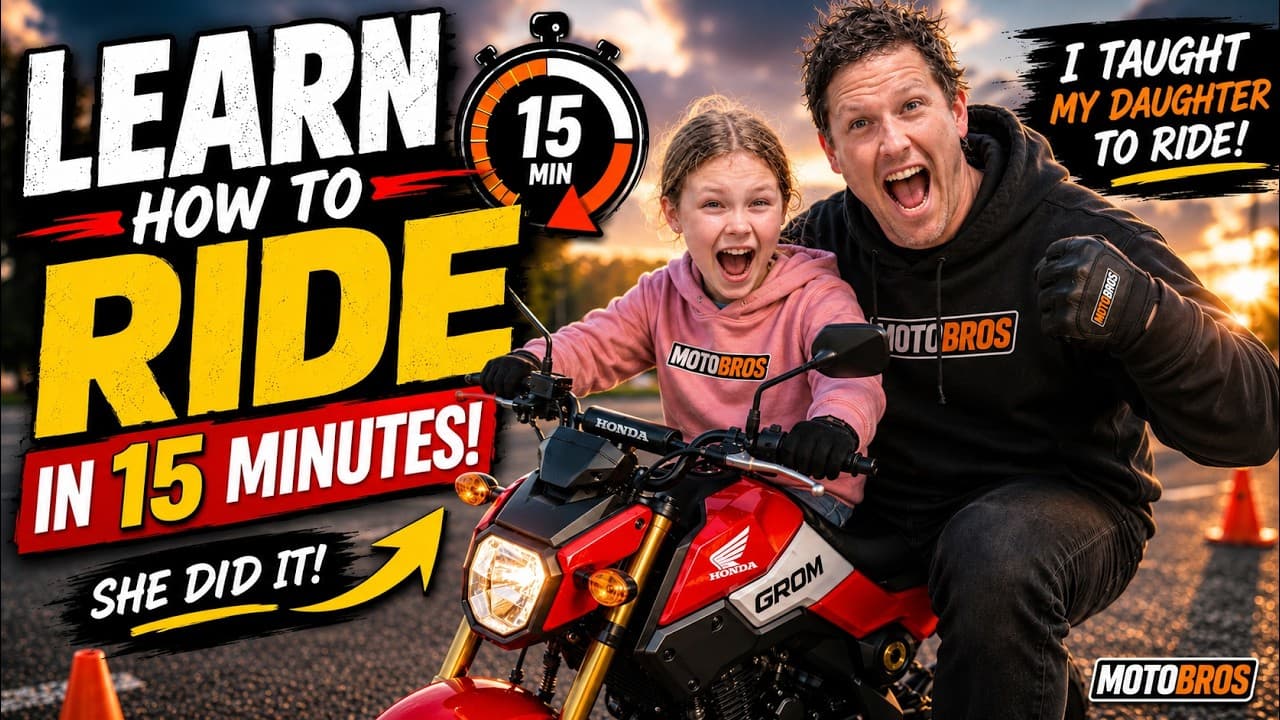
Learn to Ride in 15 Minutes
Craig teaches his daughter to ride on a Honda Grom: clutch, friction zone, first takeoffs, and a proud dad moment.
Read the vlog
Learn to Ride in 15 Minutes
Teaching My Daughter to Ride a Motorcycle: A Proud Dad Moment
I've been around motorcycles for most of my life, but this was one of those days that reminded me why I love them so much.
My daughter wanted to learn how to ride.
And I'm telling you, there is nothing quite like watching your own kid get on a motorcycle, figure out the clutch, and realize, "Hey, I can actually do this."
I was smiling the entire time.
We brought out one of our Honda Groms, took our time, and started with the absolute basics. No pressure to become a racer. No need to learn everything in one afternoon. Just a dad, his daughter, and a motorcycle.
Why We Started on a Honda Grom
My daughter has been around motorcycles her whole life, and she's ridden a CRF50 before, so she already had a little familiarity with two wheels.
But riding a manual-clutch street motorcycle is a different experience.
That's why I love using a Honda Grom for beginner training.
It's small, approachable, and not nearly as intimidating as putting somebody on a big sport bike. She could get both feet flat on the ground, the controls were manageable, and the motorcycle was a good fit for her size.
That matters.
When somebody is learning, you want them focused on understanding the motorcycle, not worrying that they can't hold it up.
A Grom isn't the perfect fit for every person, but for her, it was exactly what I wanted.
Don't Overwhelm a New Rider
One of the biggest mistakes I see people make when teaching somebody they love is trying to explain everything at once.
They start talking about all the gears, every switch, countersteering, braking, body position, and what to do in every possible situation.
Meanwhile, the new rider is sitting there thinking, "Dude, I'm just trying to figure out how to start this thing."
So I wanted to keep it simple.
We went over the basic controls, the kill switch, the starter, neutral, and how to put the motorcycle into first gear.
We also made sure she understood the brakes and how to stop safely before moving into riding practice. You don't need to teach every advanced braking technique immediately, but a beginner should know how to use both brakes and stop the motorcycle before riding.
Then we focused on one thing.
The clutch.
Finding the Friction Zone
The friction zone is where the clutch starts transferring power to the rear wheel.
For somebody who has been riding for years, it becomes second nature. You don't really think about it anymore.
But for a new rider, that feeling is everything.
I had her pull the clutch in, put the bike into first gear, and slowly release the lever until she could feel the motorcycle wanting to move.
Then pull it back in.
Do it again.
And again.
No need to rush.
At one point, the motorcycle stalled because the kickstand was still down.
I asked her why it stalled, and she had to figure it out.
That's part of learning, too.
You make a little mistake, understand what happened, and move on.
Stalling Is Not the End of the World
One of her biggest concerns was stalling the motorcycle.
She was worried about letting the clutch out too far and not giving it enough gas.
I told her that's exactly why we were practicing.
You have to learn how to coordinate the clutch and throttle. It's a balance: smoothly releasing the clutch while adding the appropriate amount of gas.
Sometimes you stall.
Sometimes you give it a little too much.
That's normal.
The important thing is not to panic or suddenly grab a handful of throttle.
If the motorcycle starts accelerating unexpectedly, close the throttle, disengage the clutch, and use the brakes to come to a controlled stop. Pulling in the clutch disconnects engine power, but it does not stop the motorcycle by itself.
That's a fundamental skill every new rider needs to understand.
The First Time She Started Moving
Once she had a feel for the clutch, we moved into a clear practice area and started working on gentle takeoffs.
I stayed close and coached her through it.
A little gas.
Easy with the clutch.
Look where you're going.
And there she went.
Of course, the first few attempts weren't perfect.
She stalled a couple of times. She gave it a little too much gas. She grabbed the front brake more abruptly than she needed to.
But that's exactly what beginner training is for.
You don't get upset with somebody because they don't know how to do something they've never done before.
You show them.
You let them practice.
And you help them build confidence.
Learning to Brake Smoothly
One thing I noticed was that she was grabbing the front brake rather than applying it progressively.
That's common when somebody is new.
They know the brake is supposed to stop the motorcycle, but they haven't developed the feel for how much pressure to use.
So we worked on that.
Close the throttle, squeeze the brake smoothly, and gradually increase pressure as needed.
You don't need to snatch the lever.
And you don't want to rely on dragging your feet to stop the motorcycle. Feet can help support the bike at a stop, but proper brake control is what we want her to learn.
We kept the speeds low and gave her plenty of room to practice.
"I'm Getting Paid in Experience"
This was probably my favorite moment of the entire day.
We were talking while she was practicing, and I asked her if she was getting paid for this.
She said, "I'm getting paid in experience."
Dude.
I lost it.
I was like, "That's somebody we need on our team!"
I love that kid.
It was such a funny little moment, but it also made me realize how much she was enjoying herself.
She wasn't just doing something because Dad wanted her to.
She wanted to learn.
And that made the whole day even better.
From the First Takeoff to Riding Around the Building
After she got more comfortable with the clutch, throttle, and brakes, we started adding a little more.
We practiced riding farther down the straightaway, stopping, turning around, and eventually making a loop around the building.
The key was not to rush into shifting through the gears.
She didn't need second, third, fourth, or fifth gear yet.
She needed to become comfortable with first gear.
Starting.
Stopping.
Looking ahead.
Turning.
Controlling her speed.
Those are the building blocks.
Once those become natural, you can start adding more advanced skills.
The Little Things You Notice as an Instructor
One thing I noticed was that she kept looking down at the controls.
That's another common beginner habit.
They're concentrating so hard on what their hands and feet are doing that they forget to look where they want the motorcycle to go.
So we worked on keeping her eyes up and looking through the path ahead.
I also watched how she handled the motorcycle when she got nervous. Sometimes a new rider will tense up, roll on the throttle unintentionally, or grab a control too quickly.
That's why I like teaching in a controlled area with plenty of space, low speeds, and an instructor who can recognize those things early.
You don't want to wait until somebody is heading toward a curb to start explaining what to do.
Protective Gear Is Part of the Lesson
In the video, I talked about how hot weather and too much information can overwhelm a beginner. I also explained that I was staying very close to my daughter during the initial stationary exercises.
But I want to make an important distinction for anybody using this as a guide.
Once a motorcycle is moving, even at very low speed, there is still a risk of falling or being injured. An instructor standing nearby cannot eliminate that risk.
For beginner riding practice, I recommend a properly fitted helmet, gloves, motorcycle jacket, long protective pants, and over-the-ankle boots. Gear should be comfortable and appropriate for the weather, and you can take breaks to avoid overheating.
You can keep the lesson simple without removing the protection.
That's the approach I want people to take away from this.
She Was Riding Within 45 Minutes
By the time we had been practicing for about 35 to 45 minutes, she was riding around the building and getting more comfortable.
She was still in first gear.
Still working on the basics.
But she was doing it.
I asked her what she thought, and she said it was really fun.
That's what I wanted to hear.
She was a little nervous, but she was enjoying herself, and she wanted to keep going.
We took breaks, made sure she had water, and kept practicing.
I also had her stop and start again on the straightaway instead of just continuously circling, because takeoffs are something you need to repeat until they become comfortable.
Learning to Ride Is Not the Same as Being Ready for the Road
This is something I really want to emphasize.
Just because somebody can start a motorcycle, ride in a straight line, and make a few turns does not mean they're ready to ride in traffic.
There is so much more to learn.
Braking in different situations.
Turning and cornering.
Shifting.
Road positioning.
Traffic awareness.
Emergency maneuvers.
Understanding hazards and making good decisions.
That takes time and practice.
I want my daughter to enjoy motorcycles, but I also want her to develop the skills and judgment to ride safely.
There is no reason to rush that process.
Why This Day Meant So Much to Me
I've taught a lot of people how to ride over the years, and I genuinely enjoy helping somebody go from nervous and unsure to smiling inside their helmet.
But teaching my daughter was different.
Watching her figure things out, seeing her confidence grow, and hearing her say she was having fun, it was a proud dad moment I'm going to remember for a long time.
At one point, I told her how proud I was, and she thanked me.
Then we joked that this could be our little secret from the rest of the family.
That's the kind of stuff that makes the day special.
Not the motorcycle.
Not the speed.
Just getting to share something I love with somebody I love.
What's Next for Her
We're going to keep practicing.
More takeoffs, more stops, more turning, and eventually shifting and the rest of the skills she needs.
I'm not in a hurry to get her out on the road. I want her to learn properly and enjoy the process.
And I'm looking forward to filming another update in a couple of months so you guys can see how far she's come.
If you're teaching somebody to ride, remember that everybody learns at a different pace. Keep the information manageable, use a motorcycle that fits them, choose a safe practice environment, and consider a certified beginner rider course.
Most importantly, be patient.
The goal isn't to see how quickly you can get somebody riding.
The goal is to help them become a confident, capable, and safe rider.
I'm so proud of you, kiddo.
Please ride safe, grow your skill, and I'll see you guys in the next one.
Craig, MotoBros
Watch the vlog
Play it here. You stay on motobros.net.
Subscribe on YouTube · Visit the shop