MotoBros Vlog · Lewisville, TX
Does Your Yamaha R7 NEED a Tune? 3 Exhausts Put to the Test
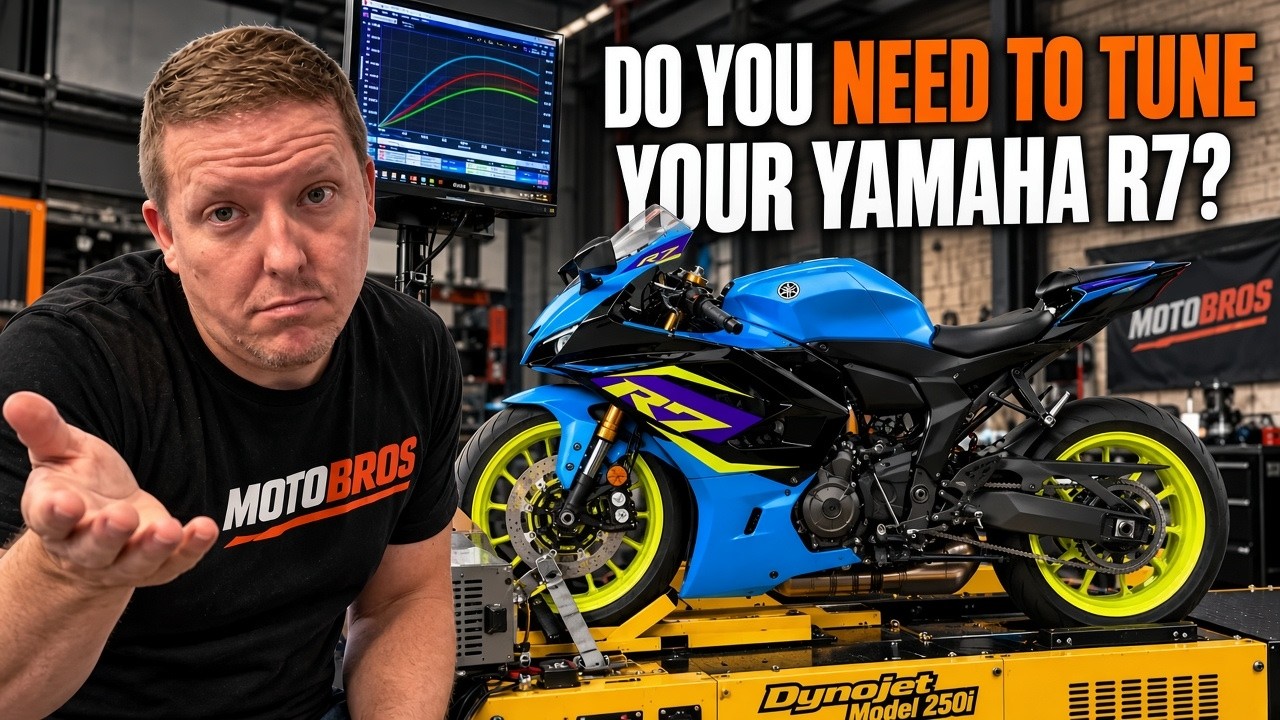
Three Yamaha R7s on the dyno with an M4, a Yoshimura, and a $220 fake Akrapovič, before any ECU tune.
Read the vlog
Does Your Yamaha R7 NEED a Tune? 3 Exhausts Put to the Test
$220 Fake Akrapovič vs. M4 vs. Yoshimura — Yamaha R7 Dyno Results SHOCKED ME!
All right, you guys.
This is the video I've been waiting to make.
We've got three Yamaha R7s sitting at MotoBros, three completely different exhaust systems installed, and we're finally going to see what happens when we put them on the dyno.
We've got the M4, the Yoshimura, and the cheap Chinese imitation Akrapovič that we've been calling the Facra.
And let me tell you something.
The results surprised the hell out of me.
But before we get to the horsepower numbers, we've got something else to settle.
Because apparently you guys have decided the Yoshimura is the best-looking exhaust.
And I don't agree.
Three Yamaha R7s. Three Exhausts. One Battle.
If you've been following this series, you know how we got here.
I originally planned to buy several exhaust systems and keep swapping them onto my own R7.
Install one.
Dyno it.
Remove it.
Install the next.
Repeat until Aaron wants to quit.
But then two customers brought their R7s into MotoBros at almost the perfect time.
Suddenly, we had three R7s sitting together.
One customer wanted the M4.
Another wanted the Yoshimura.
And I already had the cheap imitation Akrapovič installed on mine.
Perfect.
We previously established stock dyno baselines for all three motorcycles, and now we could start comparing the exhaust setups.
The important distinction is that these are three separate motorcycles, not one bike with three exhausts tested back-to-back.
That means we can compare the results, but we can't attribute every horsepower difference solely to the exhaust.
Still, this is going to be interesting.
First, Let's Talk About How These Exhausts LOOK
Before we started the sound comparison, I wanted to show you guys all three systems.
And I've got to give M4 some credit.
Their latest exhaust looked beautiful.
The welds on this particular system looked cleaner than what I'd seen on some previous examples.
The tubing looked great.
And the updated muffler tip has a little more design to it.
I like that.
It gives the exhaust a little more character without making it look ridiculous.
The Yoshimura?
Also beautiful.
I especially like the way the carbon-fiber section is designed.
It looks like a premium product.
Then there's my fake Akrapovič.
And dude...
I still think that thing looks amazing.
The titanium-style appearance works really well with the R7.
I know it's an inexpensive Chinese imitation, but visually, it surprised me.
Now, looking good doesn't tell us anything about weld durability, material quality, or long-term reliability.
And that's exactly why I'm going to keep riding it.
I want to find out whether the thing actually holds up.
Apparently Everybody Loves the Yoshimura
Before filming this comparison, I asked you guys which exhaust you liked the best.
And the comments were hilarious.
Almost everybody picked Yoshimura.
A couple people liked the M4.
And basically nobody picked my fake Akrapovič.
Thanks, guys.
I appreciate the support.
But here's where I'm going to disagree with you.
I still prefer the M4.
I like the way it sits on the motorcycle.
It's tucked up underneath.
It's compact.
It has a clean angle.
The Yoshimura looks good too, but the M4 just does it for me.
Of course, appearance is completely subjective.
So we're going to let you guys keep arguing about that in the comments.
Now let's hear these things.
Why I Stayed at the Shop Late
I wanted this sound comparison to be as useful as possible.
Not just three motorcycles sitting in a noisy shop while everybody talks over the exhaust.
I stayed late so the surrounding businesses would be quieter and we could record the bikes without as much background noise.
My plan was to let you hear each exhaust at idle, during startup, and through acceleration.
I also wanted to run them on the dyno so you could hear the engines working through the gears.
A video recording still can't perfectly reproduce how an exhaust sounds in person, especially when microphones and playback devices handle loud sounds differently.
But at least you'd have several examples to compare.
And we're starting with my favorite.
M4: The Sound I Love
First up was the M4.
The customer R7 had approximately 784 miles on it.
We rolled it outside and fired it up cold.
Oh, man.
That's what I'm talking about.
The M4 has that deeper, more aggressive tone I like.
It sounds strong without needing a massive muffler hanging off the motorcycle.
And once we started giving it some throttle?
Yep.
Still my favorite.
I've always liked M4 exhausts, and this particular setup did nothing to change my mind.
Good-looking tubing.
Clean fitment.
Aggressive sound.
Exactly what I want from an R7 exhaust.
But the real question is whether the Yoshimura can change my mind.
Not yet.
First, we've got to hear the cheap one.
The $220 Fake Akrapovič: Surprisingly Quiet
Now we rolled out my R7.
At the time, my motorcycle was approaching 4,000 miles.
And I'm still impressed with how the fake Akrapovič looks on the bike.
But when we fired it up next to the M4, something became obvious.
It's noticeably softer to my ears.
It doesn't have the same deep, aggressive sound as the M4.
The longer muffler and its internal construction appear to influence the exhaust note, although we didn't measure the acoustic effect of those features separately.
And that's not necessarily a bad thing.
Some people don't want an exhaust that attracts attention everywhere they ride.
For those riders, a quieter system might actually be preferable.
But if you're asking which one gives me that aggressive sound I love?
M4 wins this round.
Now, there's something important about the Facra.
It cost approximately $220.
That's a whole different price category.
And at that price, I can't just ignore the fact that it looks good, fits surprisingly well, and doesn't sound terrible.
The big question is still durability.
Because looking good on day one is easy.
Let's see what happens after some serious mileage.
Yoshimura: The Fan Favorite
Finally.
The Yoshimura.
This is the exhaust almost everybody picked in the comments.
And I'll admit something.
It sounds really good.
The exhaust note is much closer to the M4 than the fake Akrapovič.
It has that aggressive character you expect from a sportbike exhaust.
The muffler looks great.
The carbon-fiber detailing looks great.
The overall finish is excellent.
But when I compare the two?
I'm still picking M4.
I know.
You guys are going to hate me.
That's fine.
You can tell me how wrong I am in the comments.
But the M4 has the sound and positioning that I personally prefer.
And that's why it's important to compare these things.
What I like isn't necessarily what you're going to like.
Now Let's Hear Them Under Load
Cold starts and idle clips are great.
But I wanted more.
I wanted you guys to hear what these exhausts sound like when the motorcycle is actually accelerating.
So we recorded acceleration clips and then moved the bikes onto the dyno.
We started with the imitation Akrapovič.
Then the M4.
Then the Yoshimura.
And I was having a blast.
There's something really cool about being able to line up three nearly identical motorcycles with different exhaust systems and compare them like this.
You don't have to rely entirely on somebody telling you what sounds better.
You can listen to the recordings and decide for yourself.
And once the bikes were on the dyno, we could finally answer another question.
What kind of horsepower are these exhaust setups making before tuning?
The Dyno Results: I Couldn't Believe It
All right.
Here we go.
Remember, these are the numbers we recorded before tuning the ECUs for the new exhaust systems.
And the results were much closer than I expected.
Fake Akrapovič-style exhaust: 69.90 hp
Yoshimura: 69.87 hp
M4: 68.34 hp
Look at that.
The cheap fake Akrapovič recorded the highest peak horsepower of the three.
By 0.03 horsepower over the Yoshimura.
That's practically nothing.
Those two results are effectively tied at the precision that matters here.
The M4 came in at 68.34 horsepower, approximately 1.5 horsepower below the other two.
And remember, we're testing three different motorcycles.
Their stock baselines were already slightly different, and mileage and other testing variables can influence results.
So don't interpret this as proof that the fake exhaust makes more horsepower than Yoshimura or M4 on an otherwise identical bike.
But still...
For an exhaust that cost roughly $220?
That's pretty damn interesting.
Let's Compare Those Numbers With Stock
In our previous video, we dyno-tested all three R7s before installing these exhausts.
The stock results were extremely close, with two bikes around 65.57 horsepower and mine at 66.19 horsepower.
My R7 is the one wearing the fake Akrapovič-style exhaust.
So for my bike, we have a particularly interesting comparison.
Stock: 66.19 hp
With the fake Akrapovič-style exhaust, before ECU tuning: 69.90 hp
That's an increase of approximately 3.71 horsepower between those two reported measurements.
Now, I want to be clear.
That's an observed difference between the stock baseline and this later exhaust test, not a laboratory-isolated exhaust gain.
To draw a stronger conclusion, we'd want comparable conditions and repeated testing.
But it gives us a useful starting point.
And we haven't even tuned the bike yet.
What About the Air-Fuel Ratios?
This is where things get more interesting than the peak horsepower number.
Because horsepower isn't the only thing I'm looking at.
I'm also paying attention to the air-fuel ratio and the overall shape of the power curve.
All three exhaust setups produced smooth-looking power curves during our testing.
There weren't obvious major dips in the curves that immediately concerned me.
That's good.
But the air-fuel readings showed areas I'd like to improve.
We saw portions of the lower range that appeared leaner than our target and upper-range areas that appeared richer.
The fake Akrapovič setup was particularly rich toward the upper end of the run.
And that's where tuning comes in.
Do You HAVE to Tune Your R7 After Installing an Exhaust?
Man.
I hate answering this question because people want a simple yes or no.
Here's what I can tell you from these particular dyno runs.
The motorcycles ran and produced smooth-looking power curves without an ECU tune for the exhausts.
But that doesn't automatically mean every full-exhaust installation on every R7 is safe to operate indefinitely without tuning.
A few dyno pulls cannot establish long-term reliability, and the actual fueling needs to be evaluated for the specific setup.
My preference is to tune the bike properly.
Why?
Because I want to address the areas where fueling isn't where I want it.
I want to optimize the throttle response.
I want to improve the overall riding experience.
And I want to get the best performance we reasonably can without sacrificing reliability.
I'm not interested in some ridiculous tune that chases a headline horsepower number at the expense of the engine.
That's not what MotoBros tuning is about.
A Few Horsepower Is a Big Deal on an R7
Something else people need to understand.
If you have a motorcycle making roughly 65 horsepower at the wheel, gaining another two or three horsepower can be meaningful.
We're not talking about a 200-horsepower superbike.
We're talking about a Yamaha R7.
Every little improvement matters.
And it's not just about peak horsepower.
How the motorcycle responds when you open the throttle matters.
How smooth the power delivery feels matters.
The fueling through different throttle and RPM ranges matters.
That's why I want to tune these bikes and show you the before-and-after results.
Because that's going to tell us more than just bolting on an exhaust and looking at one number.
The Cheap Exhaust Still Has One Major Question Mark
Before everybody runs out and orders a fake Akrapovič, there's something I want you to understand.
We still don't know how long this thing is going to last.
That's a big deal.
The welds might look acceptable today.
The tubing might look good today.
The finish might look nice today.
But what happens after repeated heat cycles?
What happens after months of riding?
Will the muffler packing hold up?
Will anything crack?
Will the finish discolor?
Will the mounting hardware stay secure?
Those are questions we haven't answered.
And there are also important concerns with counterfeit products, including inconsistent materials, manufacturing quality, and lack of verified support from the genuine manufacturer.
So I'm going to keep riding mine and inspecting it.
If something goes wrong, I'll show you.
If it holds up, I'll show you that too.
That's the point of the series.
Next Up: ECU Tuning
Now we've got our first exhaust comparison results.
And the next step is the one I've really been looking forward to.
Tuning all three R7s.
We're going to go through the fueling.
Look at the curves.
Make the necessary adjustments.
And see what the final numbers look like.
Then we'll compare where each motorcycle started and where it finished.
After that, the two customer bikes can go home.
And mine?
Well, mine gets more exhausts.
We've still got another inexpensive Chinese system.
We've got LeoVince.
We've got SC-Project.
And we're going to keep testing.
Because I want this series to give you real information before you spend your money.
We're Also Selling the Test Exhausts
One more thing.
When we're finished testing these systems, several of them are going to be available through MotoBros.
Some have already been claimed.
The Yoshimura went quickly to a local customer.
And the M4 was already purchased for the other customer bike.
But as we continue testing, we'll have more systems coming off the motorcycle.
My goal is to offer good deals on the exhausts we no longer need, with tuning packages available where appropriate.
We'll announce availability through the MotoBros website and our social channels.
If you've been wanting an exhaust for your R7, keep an eye out.
My Verdict So Far
So where do I stand after this round?
Best-looking exhaust according to the comments: Yoshimura.
My personal favorite for sound and positioning: M4.
Biggest surprise: The approximately $220 fake Akrapovič-style system.
And when it comes to horsepower?
The fake Akrapovič and Yoshimura were virtually tied at around 69.9 horsepower, with the M4 recording 68.34 horsepower on its bike.
That's where we are before tuning.
But we're nowhere near finished.
I want to know how these bikes respond to proper ECU tuning.
I want to see the final curves.
And I want to know whether that cheap exhaust is still looking good after we've put some real miles on it.
So let me know in the comments.
Which one would YOU put on your Yamaha R7?
M4?
Yoshimura?
Or would you take a chance on the cheap one?
I already know what I'm picking.
And apparently almost all of you disagree with me.
That's what makes this fun.
Thanks for watching and supporting MotoBros.
Ride safe, and I'll see you guys in the next one.
Craig, MotoBros
Watch the vlog
Play it here. You stay on motobros.net.
Subscribe on YouTube · Visit the shop