MotoBros Vlog · Lewisville, TX
Which Motorcycle Oil Filter Is Actually the Best?
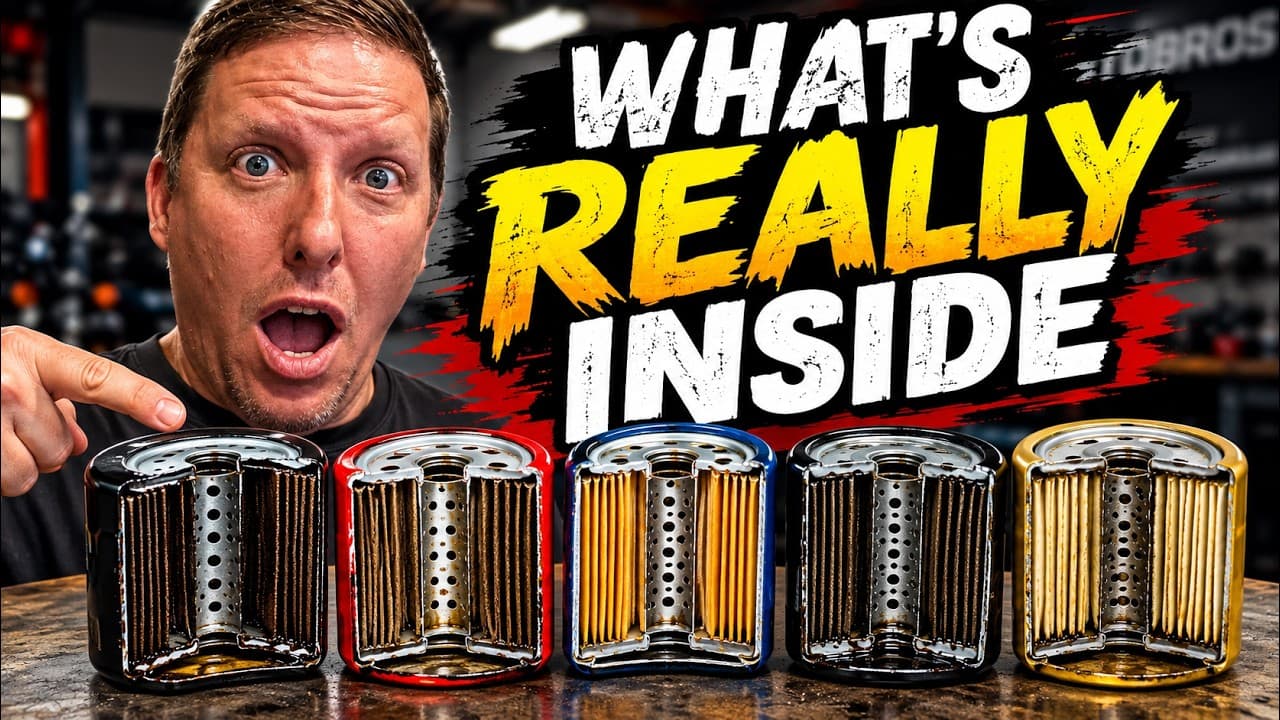
We cut open Hiflofiltro, Pro Filter, Yamaha Genuine, and K&N oil filters to see what you actually get from $9 to $20.
Read the vlog
Which Motorcycle Oil Filter Is Actually the Best?
We Cut Open Motorcycle Oil Filters… and I Was Shocked
I've been working on motorcycles for 30 years, and every once in a while, something still comes along that genuinely surprises me.
This was one of those days.
I went out and bought some of the most popular motorcycle oil filters, ranging from about $9 to $20, because I wanted to answer a simple question: Are you actually getting a better filter when you spend twice as much, or are you just paying for the name?
I've used some of these filters for years, but I had never cut them open and compared them side by side. So Aaron and I got the tools out, made a mess, and started digging.
And I'm telling you, I did not expect what we found.
Five Filters, Four Brands, and a Big Price Difference
We had Hiflofiltro, Pro Filter, Yamaha Genuine, and K&N on the bench, with prices ranging from $8.95 to $19.99.
The Hiflofiltro was the cheapest at $8.95. Pro Filter came in at $12.99, Yamaha was $15.99, and K&N was the most expensive at $19.99.
I honestly expected Yamaha to be the most expensive. It's the OEM filter, after all.
Before we even started cutting, Aaron was already making fun of my handwriting. Apparently, after 30 years of working on motorcycles, I still can't write a price tag properly.
So I let him handle that part.
Then we got to the fun stuff.
The Cheapest Filter Was Our First Surprise
We started with the Hiflofiltro because it's a filter I've used a lot, and it has never let me down.
I was hoping it would look good inside, but I had no idea what to expect.
The first thing I noticed was that the sealing gasket came pre-lubricated. That's a nice touch, especially for somebody doing their own oil change for the first time.
Then we cut the housing open and started pulling everything apart.
The construction looked good. The internal components were solid, the filter media looked well supported, and the gasket was seated securely.
I was impressed.
For the cheapest filter on the bench, it looked like a quality piece of equipment.
And that's exactly why I wanted to do this video. You can look at a box all day long, but until you actually open something up, you don't really know what you're buying.
Pro Filter: More Money, Less Media?
Next up was the Pro Filter.
I'd never used this one before, so I was curious to see what we were getting for the extra money.
It had a nut on the end of the housing, which I'm personally not a huge fan of. I've seen concerns with welded nuts on certain oil filters before, so that's something I pay attention to.
The gasket also wasn't pre-lubricated like the Hiflofiltro.
That's not a deal-breaker, but if you're installing a filter, make sure you follow the manufacturer's instructions and lubricate the gasket when required. You don't want it sticking to the engine and creating problems the next time you change your oil.
Once Aaron finally got the thing apart, because apparently he's the strong one now, we started comparing the internals.
A lot of the components looked very similar to the Hiflofiltro.
But then we pulled out the filter element.
And that's where things got interesting.
The Pro Filter had noticeably less media in the element we opened. We were looking at it side by side, and I couldn't believe how much smaller it appeared.
Now, Aaron made a good point: you can't judge filtration performance just by looking at the amount of media. The type of material, efficiency, flow, and dirt-holding capacity all matter.
He was right.
But from a construction standpoint, I expected more from the filter that cost several dollars extra.
Yamaha Genuine: This Is What I Wanted to See
Then we got to the Yamaha OEM filter.
I had high expectations for this one, and I was really hoping it wouldn't let me down.
The gasket was pre-lubricated, and as soon as we started taking it apart, I could tell the construction was different.
The sealing components were harder to remove, the internal design looked more substantial, and when we got the filter element out, I was genuinely impressed.
The media looked excellent.
The internal support and flow path were different from the other filters we had opened, and the whole assembly looked like a very well-thought-out design.
I kept looking at Aaron going, "Dude, look at this."
This is the kind of thing I love seeing.
You spend $15.99, and you can actually see where some of that money is going.
Now, I want to be clear: cutting a filter open doesn't tell us its exact micron rating, filtration efficiency, or flow performance. We would need proper testing for that.
But based on the construction we could inspect, the Yamaha filter was easily my favorite of the bunch.
Then We Opened the K&N…
This was the one I was most curious about.
At $19.99, it was the most expensive filter on the bench.
I expected something different. Maybe better media, a more substantial internal design, or something that would make the price make sense.
We cut it open.
Pulled out the internals.
And I just stood there looking at it.
"Dude… no way."
Aaron and I started putting the parts next to the Hiflofiltro, and the similarities were unbelievable.
The internal design, the center tube, the components, it all looked extremely close to the cheaper filter.
The media had a different appearance and was slightly larger, but the overall construction was so similar that I honestly couldn't believe what I was seeing.
I kept saying, "There's no shot."
I've used Hiflofiltro for years, and I knew they were good filters. But seeing the K&N next to it at more than double the price was a huge surprise.
We checked the boxes and saw that both were marked as made in Thailand. That made me wonder whether they could share a manufacturer or supplier, but we can't confirm that just from the country of origin and visual similarities.
What I can say is that the filters we opened looked remarkably similar inside.
And for me, that raised a big question about the value of the K&N.
What About the Actual Filter Media?
This is where I want to make an important distinction.
We looked at the media, compared the construction, and talked about the different materials the manufacturers advertise.
Hiflofiltro uses cellulose-based media, Pro Filter describes its media as advanced paper, Yamaha advertises a synthetic-fiber design, and K&N describes a resin-impregnated paper-based media.
But you cannot determine exact filtration efficiency by touching the material or looking at it under shop lights.
To really know which filter captures the smallest particles, which one flows the best, and which one holds the most contamination, we would need controlled laboratory testing.
That's something I'd love to explore in the future.
This video was about opening them up and seeing what the manufacturers actually put inside.
And from that perspective, the differences were fascinating.
We Also Cut Open a Used Filter
I saved a used Hiflofiltro from a customer's motorcycle because I wanted to see what it looked like after a long service interval.
The customer had bought a used bike, and the previous owner had claimed the oil had been changed.
Well, when we drained it, the oil looked and smelled terrible.
That's one of the reasons I always tell people to be careful when buying a used motorcycle. If somebody says they changed the oil, that doesn't necessarily mean you should take their word for it.
If you don't have service records, it's worth doing the maintenance yourself so you know where you stand.
We cut the used filter open and inspected the media, gasket, and internal components.
There was some deformation around the sealing area, but it appeared to be related to the way the gasket had been compressed and removed. We didn't see obvious internal deterioration in the parts we inspected.
That was encouraging, especially considering how neglected the oil appeared to be.
But it's not a reason to extend your oil-change intervals. Follow your motorcycle manufacturer's maintenance schedule and use the correct filter for your bike.
My Ranking After Cutting Them Open
After everything we saw, here's how I ranked the filters based on this teardown and my own preferences.
4th Place: K&N
This was the biggest disappointment for me. The price was the highest, but the internal construction looked extremely similar to the much cheaper Hiflofiltro.
I'm also cautious about certain filter designs with welded removal nuts because of historical issues involving specific models. That doesn't mean every current K&N filter is defective, but it is something I consider when choosing what to use in the shop.
For the money, I personally didn't see enough in this teardown to justify the premium.
3rd Place: Pro Filter
The Pro Filter had some nice components, but the smaller media element and the lack of a pre-lubricated gasket left me wanting more.
It may perform very well in proper testing, but based on what we could see, it wasn't my favorite value.
2nd Place: Hiflofiltro
This one made me happy.
It was the cheapest filter we opened, and the construction looked solid. The used example also gave us a chance to see how one had held up in service.
I've used these for years, and this teardown gave me even more confidence in the value they offer.
1st Place: Yamaha Genuine OEM
Without a doubt, this was my favorite.
The construction, media appearance, internal support, and overall design impressed me the most.
At $15.99, it wasn't the cheapest, but it also wasn't the most expensive. Based on what we saw, I felt like I was getting my money's worth.
Again, this is my teardown ranking, not a laboratory filtration test, but the Yamaha filter was the clear winner for me.
This Is Why I Love Doing These Videos
I've been around motorcycles for a long time, and I still love learning something new.
I went into this expecting the expensive filters to have some obvious advantages. Instead, the cheapest filter impressed me, the Yamaha OEM filter looked fantastic, and the most expensive filter left me scratching my head.
That's why I want to keep doing more of these breakdowns.
Not just oil filters, either.
I want to cut things open, compare parts, test products, and show you guys what you're actually getting for your money.
We've also got an OEM oil-filter comparison coming, where we'll take a closer look at filters from different motorcycle manufacturers.
If you enjoy this kind of content, hit the subscribe button and turn on notifications. It's a free way to support the channel, and it helps us keep making videos like this.
I appreciate every one of you who watches, comments, and comes along for the ride.
This one definitely opened my eyes.
Please ride safe, grow your skill, and I'll see you guys in the next one.
Craig, MotoBros
Watch the vlog
Play it here. You stay on motobros.net.
Subscribe on YouTube · Visit the shop